Cycling with Arthritic Knees: How E-Bikes Can Help

Arthritis can make everyday activities, including walking, painful. It affects many people—one in four Americans experiences chronic knee pain. The good news? The right kind of exercise can protect your joints and relieve pain, rather than making it worse.

Low-impact exercises are particularly important for arthritic knees, and cycling is one of the best options. It improves cardiovascular health, strengthens muscles, increases mobility, and provides a good workout without the heavy impact of running or high-intensity training.

Electric bikes (e-bikes) offer added comfort. Their motor assistance lets you adjust how much effort is needed for each pedal stroke, reducing strain on your knees and making rides more enjoyable and longer-lasting.

This guide explores why cycling—especially with an e-bike—is excellent for those with knee arthritis and highlights key features to look for in a bike that promotes comfort and minimizes knee strain.

Why Cycling Is Beneficial for Arthritic Knees

- Low-Impact Activity: Cycling puts minimal stress on your knees. Unlike running, it allows the knee to move smoothly through a controlled range of motion, improving flexibility and reducing stiffness.

- Strengthens Muscles: Pedaling works the quadriceps, hamstrings, and calves, supporting the joint and easing discomfort.

- Improves Mobility & Stability: Stronger muscles around the kneecap help carry body weight efficiently, reducing pressure on arthritic joints.

- Supports Weight Management: Excess weight adds stress to knees—cycling can help maintain a healthy weight, easing joint burden. (Every 10 pounds of body weight adds 15–50 pounds of pressure on the knees.)

Cycling as a Cardiovascular Exercise

- Heart Health: Cycling improves circulation, lung capacity, and overall cardiovascular fitness.

- Low-Impact Cardio: Provides efficient cardiovascular exercise without stressing the knees.

- Weight Control: Helps manage weight, reducing arthritis symptoms and improving mobility.

Versatility for All Fitness Levels

Cycling adapts to different fitness levels:

- Recumbent Bikes: Reduce knee pressure for beginners.

- Upright Bikes: Suitable for more experienced riders.

- Stationary Bikes: Indoor option for bad weather.

- Outdoor Cycling: Offers mental health benefits—stress reduction, improved mood, and a sense of achievement.

- Electric Bikes: Adjustable pedal assistance allows a customized workout—more help for hills, relaxed rides on flat terrain.

Key Features to Look for in a Bike for Arthritic Knees

1. Adjustable Seat
Fine-tune saddle height and position for a comfortable, supportive posture, reducing knee strain.

2. Low-Frame Height
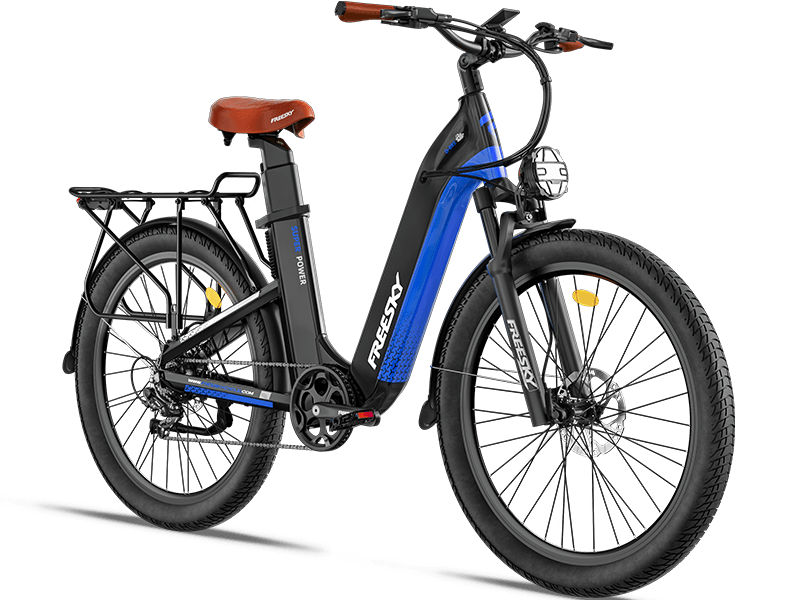
Models like Ranger M-540, Wild Cat Ultra A-340, Rocky Pro A-320 have low-step frames, making mounting and dismounting easier and safer.

3. Smooth Gearing System
Low gears and adjustable resistance let you pedal comfortably without excessive force, protecting your knees.

4. Electric Assist System
5-level motor assistance helps take the load off your knees. Adjust intensity to match terrain and comfort level.

Tips for Biking with Arthritic Knees

- Invest in Cycling Gear: Helmet, gloves, eye protection, bright clothing, and comfortable form-fitting clothes.

- Warm-Up First: Light stretches and joint mobility exercises prepare your knees.

- Start Small: Begin with 5–10 minute rides at low resistance; gradually increase duration and intensity.

- Stretch Daily: Pre- and post-ride stretches improve flexibility and mobility.

- Stop if You Feel Pain: Adjust seat or riding position; consult a professional if discomfort persists.

Summary

Freesky electric bikes are designed for riders with knee arthritis. Features like adjustable seats, low-step frames, smooth gearing, and electric assist provide a comfortable, customizable riding experience. Whether you're a beginner or seeking low-impact exercise, Freesky e-bikes let you ride longer and more comfortably while protecting your knees.

Leave a comment

More Posts

Common Beginner eBike Mistakes (and How to Avoid Them)

Apr 06, 2026

Getting your first FREESKY eBike opens up a different kind of riding experience—more power, more range, and more freedom. At the same time, there’s a short adjustment period as you get used to how an electric bike behaves compared to a traditional one. Most beginner mistakes are not serious—and more importantly, they’re easy to correct once you understand them. With FREESKY’s focus on power delivery, stability, and long-range performance, you already have a solid foundation to build on. Here are the most common beginner mistakes—and how to avoid them. 1. Relying Too Much on Pure Power The instant torque from a FREESKY eBike—especially dual motor models like the Warrior Pro—can be tempting to use constantly. But overusing full power can: - Drain the battery faster - Reduce total riding range - Make control feel less refined over time What to do instead:Use pedal assist as your primary mode, and treat full throttle or maximum assist as a tool rather than the default. FREESKY’s torque-focused motor systems are designed to respond naturally to your pedaling input. Learning to balance effort and assistance will give you both better control and longer rides. 2. Staying in High Assist Mode All the Time Many riders pick a high assist level and never change it. While it feels powerful, it’s not always efficient. This can lead to: - Faster battery consumption - Less precise control at low speeds - Jerky acceleration in tight situations What to do instead:Adjust assist levels based on conditions: - Low assist → city riding, traffic, tight turns - Medium assist → daily cruising - High assist → hills, off-road, or when needed For turning and maneuvering, reduce assist beforehand. High torque during a turn can create unexpected acceleration. FREESKY’s tuning emphasizes smooth torque delivery, but proper assist selection still makes a noticeable difference. 3. Overlooking Tire Pressure It’s easy to ignore, but tire pressure directly affects performance. Incorrect pressure can: - Reduce efficiency and range - Affect traction and stability - Increase puncture risk What to do instead:Check tire pressure regularly—especially before longer rides or off-road use. FREESKY’s fat tires are designed for versatility across terrain. Keeping them properly inflated ensures you get the intended grip, comfort, and efficiency. 4. Braking Too Late Compared to traditional bikes, eBikes are heavier and carry more momentum—especially high-power models. A common issue is delaying braking and then stopping abruptly. What to do instead: - Anticipate stops earlier - Apply brakes progressively - Practice controlled deceleration FREESKY eBikes are equipped with hydraulic disc brakes, offering consistent and strong stopping power—but technique still matters. 5. Misjudging Real-World Range Published range figures are based on ideal conditions. In real use, several factors influence battery performance: - Terrain (hills vs flat) - Rider weight - Assist level - Wind resistance - Riding style What to do instead: - Monitor battery levels during rides - Adjust assist proactively - Learn your typical range over time Models like the Alaska Pro, with dual-battery configurations, are designed for extended range—but efficient riding habits are still key to maximizing distance. 6. Skipping the Adjustment Phase It’s common to jump straight into high-speed riding. However, confidence comes from familiarity. What to do instead:Spend your first few rides focusing on: - Acceleration response - Braking feel - Turning behavior - Weight balance Even a few miles of controlled riding helps you adapt significantly. FREESKY’s full suspension setups and stable geometry—especially on models like Warrior Pro and Alaska Pro—make this process smoother and more predictable. 7. Ignoring Basic Fit and Setup Small adjustments have a large impact on comfort and control. Key factors include: - Saddle height - Handlebar position - Riding posture What to do instead:Dial in your setup early. A proper fit improves: - Efficiency - Comfort over long distances - Overall handling FREESKY frames are designed with rider adjustability in mind, allowing you to fine-tune your position for different riding styles. Ride Smarter from Day One Every rider goes through a learning curve. The goal is not to avoid mistakes entirely—but to recognize and correct them quickly. With FREESKY eBikes, you benefit from: - High-torque motor systems - Long-range battery configurations - Stable, full-suspension designs Combined with the right riding habits, these features help you get more performance, more control, and more enjoyment from every ride.

Read More

Tips for Riding a Long Range E-Bike on Unpaved Roads

Apr 01, 2026

Long Range e-bikes are built for adventure and endurance. With high-capacity batteries, efficient motors, and stable frames, they let you cover more ground than a typical e-bike—gravel trails, forest paths, dirt roads, and even light off-road sections. But riding off the pavement isn’t just about battery life or speed—it’s about handling your bike efficiently. Here are practical tips to make the most of your Long Range e-bike on unpaved terrain.   1. Adjust Tire Pressure for Traction Tire pressure is crucial for stability and comfort. - On smooth roads: Maintain moderate pressure (20–25 PSI) to reduce rolling resistance. - On soft surfaces: Drop it to 10–15 PSI to increase the contact patch and improve grip. Lower pressure helps your tires float over sand, gravel, or loose dirt rather than digging in. It also acts as additional suspension for a smoother ride. Pro tip: Keep a portable pump and a digital gauge with you—you’ll often need to adjust pressure as conditions change.   2. Optimize Your Riding Position Your body is part of the suspension system. - Stand on the pedals over rough patches, keeping knees and elbows loose. - Shift weight back on descents to avoid the front wheel digging in. - Lean forward slightly when climbing loose hills to maintain traction. Think of your bike and body as a single unit—flexibility is key.   3. Use Pedal Assist Strategically Long Range e-bikes often have moderate to strong motors. Managing power is crucial on loose terrain. - On climbs: Apply steady pedal assist instead of sudden bursts to prevent wheel spin. - On descents: Reduce assist or turn it off; momentum alone may be enough. - On flat unpaved surfaces: Mid-level assist helps you cruise comfortably without losing control.   4. Scan the Terrain Ahead Anticipate changes to maintain stability. - Look 10–20 feet ahead to identify rocks, roots, soft sand, or washboard sections. - Stand and let the bike move beneath you on rough patches. - Keep momentum through deep sand or mud; stopping abruptly can cause you to sink.   5. Brake with Care Stopping on loose terrain requires anticipation. - Use both brakes gently. Heavy front braking can cause washouts. - Slow before corners, not during, then release brakes as you navigate the turn. - On descents, feather brakes rather than holding continuously to maintain control and prevent overheating.   6. Pick Your Line Carefully Unlike paved roads, unpaved trails require choosing your path. - Follow firmer surfaces like compact dirt, small gravel, or packed sand. - Avoid the center of tracks where loose material gathers. - Take wide lines into corners, apex late, exit smoothly—similar to dirt bike technique.   7. Gear Up for the Conditions Unpaved roads mean dust, mud, and low branches. - Wear protective glasses or tinted lenses. - Helmets with visors help block branches and sun glare. - Gloves with good grip reduce hand fatigue from vibration.   8. Bring Essentials for Remote Rides Breakdowns are trickier off-road. Pack: - Spare tube, patch kit, and tire levers - Mini pump or CO₂ inflator - Multi-tool with hex keys - Water and a snack - Phone and basic first aid Even long-range bikes can suffer from punctures or minor mechanical issues.   9. Know Your E-Bike’s Limits Not all long-range e-bikes handle every surface equally. - Match expectations to your bike. Some excel on fire roads, gravel trails, and moderate singletrack, but aren’t full-suspension mountain bikes for extreme downhill. - Learn your bike’s handling, weight distribution, and torque response on different surfaces.   10. Respect Nature Unpaved paths often run through sensitive areas. - Stay on designated trails to avoid damaging vegetation. - Avoid creating ruts in wet conditions. - Pack out everything you bring in.   Final Thoughts: Confidence Grows with ExperienceRiding a long-range e-bike on unpaved roads is a skill developed gradually. Start with easy trails, then move to looser surfaces. Each ride teaches how your bike reacts, how to read the terrain, and how to move fluidly with your bike. With proper tire pressure, smart use of assist, and careful body positioning, you can explore further, ride longer, and enjoy every off-pavement adventure.

Read More

Ranger AIR Review: Real-World Power Meets Intelligent Riding

Mar 19, 2026

CLIMB. CRUISE. CONQUER. Specs alone don’t define a great eBike—real performance does. The FREESKY Ranger AIR delivers 3500W dual motor power, AI-driven control, and long-range capability, all validated in real-world riding conditions. From steep climbs to city cruising, this eBike is designed for riders who demand power, versatility, and comfort. Watch Real Riders Test the Ranger AIR Instead of relying on marketing claims, see how the Ranger AIR performs in real-world conditions—from unboxing to hill climbs and long-distance rides. 1. Real Ride Test: Power, Range & Unexpected Moments @Hazers (214K followers) tested: - Dual motor acceleration and torque response - Real riding range (~31 miles under test conditions) - Handling on mixed terrain - Practical observations and tips Takeaway: Power delivery is strong, smooth, and reliable. 👉 Watch Full Test & Shop Ranger AIR 2. Budget vs Performance: Is It Worth It? @citizencycle (53.5K followers) evaluated: - Value for money - Real-world usability - Comparison with other budget eBikes Takeaway: High performance without premium price. 👉 See Details & Buy Now 3. New Release Overview: First Impressions @Electric Vehicles Space (223K followers) highlighted: - Dual motor capability - Versatility across riding scenarios - Ideal for urban and off-road adventures Takeaway: Feature-rich, reliable, ready to ride. 👉 Explore & Purchase Ranger AIR 3500W AI Dual Motor: Power That Adapts to You The Ranger AIR is powered by a 3500W dual motor system delivering up to 200Nm torque, with AI-driven power distribution. Key benefits: - Automatically adjusts torque for terrain - Reduces rider effort by up to 20% - Handles 40° slopes and rough dirt roads with ease This makes riding effortless while maintaining full control. Experience Effortless Riding → Shop Now Up to 105 Miles Range: Built for Real Distance Equipped with a 48V 25Ah removable battery, the Ranger AIR can reach up to 105 miles on a single charge. Advantages: - Long-distance commuting or adventure rides - 3A fast charging for minimal downtime - Detachable for indoor charging - BMS protection for battery safety Ride Farther with Ranger AIR → Order Today Full Suspension + Fat Tires: Comfort Across Terrain Designed for stability and comfort: - Adjustable hydraulic full suspension - 26” fat tires for traction - Step-through frame for easy mounting (fits riders 5’4”–6’8”) Benefits: - Absorbs over 90% of road vibrations - Stable and smooth on dirt, gravel, and pavement - Comfortable for long rides across all terrains Ride Smooth & Stable → Get Yours Now 7 Riding Modes: One Bike, Multiple Scenarios The Ranger AIR adapts to every situation with 7 riding modes: - Dual motor / single motor - Pedal assist - Throttle-only - Cruise control - Walk assist - Manual pedaling From steep climbs to casual cruising, switching is seamless. Customize Your Ride → Buy Ranger AIR Smart Features That Improve Daily Use - Advanced LCD display showing speed, battery level, and distance - NFC keyless unlock system for card or smartphone access - Simplified and secure daily operation Smart, Secure, Ready → Shop Now What Real Riders Say - “Amazing bike for the price. Impressive performance on a budget.” — Vitalie V.- “The bike is a beast. I bought it for the dual motor.” See Why Riders Love Ranger AIR → Order Here Final Verdict: Tested, Not Just Promised The FREESKY Ranger AIR combines: - 3500W dual motor with 200Nm torque - AI-assisted riding system - Up to 105 miles range - Full suspension and fat tires for comfort - Validated by real-world rider tests It’s powerful, versatile, and reliable—ready for commuting, off-road adventures, and everything in between. Conquer Any Terrain → Buy Ranger AIR Now

Read More

0
Bike Comparison